
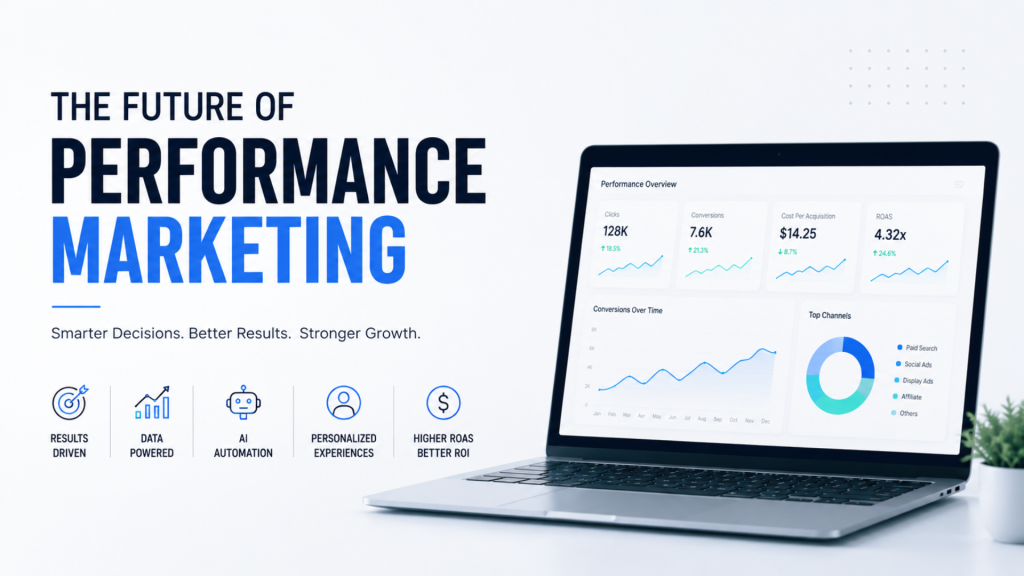
Performance marketing has become the backbone of modern digital advertising. Unlike traditional marketing, where brands pay for visibility alone, performance marketing focuses on measurable outcomes such as clicks, leads, conversions, app installs, and revenue.
In 2026, performance marketing is entering a new era powered by artificial intelligence, automation, predictive analytics, creator economies, and hyper-personalization. The industry is evolving faster than ever before.
In this guide, you’ll learn:
What performance marketing looks like in 2026
Industry growth statistics
Major trends shaping the future
The role of AI and automation
Challenges marketers face
Predictions for 2030 and beyond
What Is Performance Marketing?
Performance marketing is a results-driven digital marketing strategy where advertisers only pay when a specific action occurs.
These actions may include:
Website clicks
Product purchases
Lead generation
App downloads
Email signups
Video views
Major performance marketing channels include:
Google Ads
Meta Ads
TikTok Ads
YouTube Ads
Affiliate Marketing
Influencer Marketing
Native Advertising
Programmatic Advertising
Unlike traditional advertising, performance marketing is highly measurable, scalable, and data-driven.
The State of Performance Marketing in 2026
Performance marketing is experiencing rapid global growth.
Digital advertising continues to dominate media spending worldwide while businesses increasingly demand measurable ROI and real-time attribution.
Performance marketing is no longer just about running ads. It is about building intelligent growth systems powered by data and automation.
Why Performance Marketing Is Growing So Fast
Several factors are accelerating the growth of performance marketing.
1. Businesses Demand Measurable ROI
Companies want clear answers to questions like:
How much revenue did a campaign generate?
What was the cost per acquisition?
Which channel performed best?
Which audience delivered the highest lifetime value?
Performance marketing provides these answers through data-driven decision-making.
2. AI Has Changed Performance Marketing
Artificial intelligence is transforming how campaigns are managed.
AI helps marketers:
Generate creatives
Optimize bidding strategies
Predict conversions
Segment audiences
Personalize advertisements
Automate testing
Modern performance marketing platforms increasingly rely on machine learning rather than manual optimization.
3. Social Commerce Is Fueling Performance Marketing
Platforms such as Instagram, TikTok, and YouTube are becoming ecommerce ecosystems.
Consumers now:
Discover products through creators
Purchase directly within apps
Engage with shoppable videos
Buy products during livestreams
This creates massive opportunities for performance marketing campaigns focused on conversions.
Major Trends Shaping the Future of Performance Marketing
AI-Driven Campaign Automation
Artificial intelligence is becoming an autonomous campaign manager.
Future performance marketing systems will:
Launch campaigns automatically
Allocate budgets dynamically
Predict winning creatives
Pause underperforming ads
Personalize messaging in real time
Hyper-Personalization
Consumers increasingly expect personalized experiences based on:
Interests
Purchase history
Behavior
Device usage
Location
Hyper-personalization is becoming a core pillar of performance marketing.
Video Performance Marketing
Short-form videos are becoming the highest-performing content format.
Brands are investing heavily in:
YouTube Shorts
Instagram Reels
TikTok Ads
AI-generated video ads
Video-based performance marketing often delivers higher engagement and conversion rates.
Retail Media Networks
Retail advertising platforms are becoming major growth channels.
Examples include:
Amazon Ads
Walmart Connect
Flipkart Ads
Instacart Ads
These platforms allow brands to target users close to making a purchase.
Creator-Led Performance Marketing
Influencer marketing is evolving into performance-driven creator partnerships.
Brands now focus on:
Affiliate conversions
ROAS
Sales attribution
Customer acquisition cost
Micro creators often outperform celebrity influencers because of higher trust and engagement.
Cookieless Advertising
Privacy regulations are reshaping performance marketing.
Brands are increasingly relying on:
First-party data
Contextual targeting
Predictive attribution
Server-side tracking
The Role of AI in Performance Marketing
Artificial intelligence is becoming the engine behind modern performance marketing.
By 2030, AI may handle:
Audience targeting
Campaign budgeting
Ad creation
Landing page optimization
Customer journey prediction
Dynamic pricing
Future marketers will focus more on strategy and creativity rather than manual execution.
Biggest Challenges in Performance Marketing
Rising Advertising Costs
Competition across advertising platforms continues to increase.
This leads to:
Higher acquisition costs
Increased bidding competition
Lower margins
Attribution Complexity
Consumers interact across multiple channels before making purchases.
As a result, attribution has become one of the biggest challenges in performance marketing.
AI Content Saturation
As AI-generated content increases, audiences are becoming overwhelmed with repetitive advertisements.
Creativity and authenticity are becoming more valuable than ever.
Consumer Trust Issues
Consumers are increasingly concerned about:
Data privacy
AI-generated content
Personalized targeting
Brands that prioritize transparency will build long-term trust.
The Future of Performance Marketing Between 2027 and 2035
The next decade could completely redefine performance marketing.
Autonomous AI Ad Systems
Predictive Advertising
Conversational Commerce
Voice Search Optimization
Augmented Reality Advertising
Immersive Ecommerce Experiences
AI Search Optimization
Performance marketing is evolving from campaign management into intelligent growth engineering.
Skills Required for Future Performance Marketing
Future marketers will need:
AI tool mastery
Data analytics
Conversion optimization
Consumer psychology
Automation systems
Attribution modeling
Creative strategy
Video storytelling
Prompt engineering
Frequently Asked Questions
What is performance marketing?
Performance marketing is a digital marketing strategy where advertisers pay only when specific actions such as leads, clicks, or sales occur.
Why is performance marketing important?
Performance marketing helps businesses achieve measurable ROI and scale customer acquisition efficiently.
Which platforms are best for performance marketing?
Google Ads, Meta Ads, YouTube Ads, TikTok Ads, and affiliate marketing platforms are among the most effective channels.
Is AI changing performance marketing?
Yes. AI is improving campaign optimization, personalization, audience targeting, and automation.
What skills are required for performance marketing?
Key skills include analytics, AI tools, conversion optimization, creative strategy, and consumer psychology.
Final Thoughts
Performance marketing in 2026 is smarter, faster, and more automated than ever before.
Artificial intelligence, hyper-personalization, social commerce, predictive analytics, creator-led advertising, and immersive experiences are shaping the future of digital growth.
Businesses that embrace performance marketing and focus on customer experience will gain a significant competitive advantage in the years ahead.
Performance marketing is no longer just an advertising strategy.
It is becoming the operating system of modern business growth.
About the Author
Sahil Gupta Digital Marketer in Nashik specializes in Google Ads, Meta Ads, SEO, website development, and performance marketing strategies that help businesses generate leads and scale revenue through data-driven growth.
In 2026, performance marketing is entering a new era powered by artificial intelligence, automation, predictive analytics, creator economies, and hyper-personalization.
The industry is evolving faster than ever before.
This blog explores:
- What performance marketing looks like in 2026
- Key industry statistics and market growth data
- Major trends shaping the future
- The role of AI and automation
- Challenges marketers face
- Predictions for 2030 and beyond
What Is Performance Marketing?
Performance marketing is a results-driven digital marketing strategy where advertisers only pay when a specific action occurs.
These actions may include:
- Website clicks
- Product purchases
- Lead generation
- App downloads
- Email signups
- Video views
The major channels used in performance marketing include:
- Google Ads
- Meta Ads
- TikTok Ads
- YouTube Ads
- Affiliate marketing
- Native advertising
- Influencer campaigns
- Programmatic advertising
Unlike traditional advertising, performance marketing is highly measurable, scalable, and data-driven.
The State of Performance Marketing in 2026
Performance marketing is experiencing explosive global growth.
The digital advertising industry is expected to approach $972.5 billion in global ad spend in 2026, with projections reaching nearly $1.48 trillion by 2029. (Yahoo Finance)
At the same time:
- Digital advertising now represents nearly 73% of global media spend. (Digital Applied)
- AI-powered marketing technologies are rapidly transforming campaign execution.
- Automation is replacing many manual optimization tasks.
- Brands are demanding stronger ROI tracking and real-time attribution.
Performance marketing is no longer just about buying ads — it is now about building intelligent growth systems.
Performance Marketing Industry Growth Statistics
Global Digital Ad Spend Growth
| Year | Estimated Global Digital Ad Spend |
|---|---|
| 2024 | ~$772 Billion |
| 2026 | ~$972 Billion |
| 2029 | ~$1.48 Trillion |
Sources estimate the market could grow at a CAGR between 11% and 15% over the next several years. (Yahoo Finance)
AI in Performance Marketing Growth
The AI performance marketing market is projected to grow from:
- $9.4 billion in 2026
to - $38.7 billion by 2036
with a CAGR of approximately 15.2%. (Future Market Insights)
Meanwhile, the broader AI-in-marketing industry could surpass $82 billion by 2030. (Grand View Research)
Why Performance Marketing Is Growing So Fast
Several major factors are driving this growth.
1. Businesses Demand Measurable ROI
Companies now expect clear answers to questions like:
- How much revenue did this campaign generate?
- What was the cost per acquisition?
- Which channel converted best?
- Which audience generated the highest lifetime value?
Performance marketing provides measurable answers instantly.
2. AI Has Changed Advertising Forever
Artificial intelligence is now deeply integrated into advertising systems.
According to marketing research:
- About 94% of marketers plan to use AI in content creation in 2026. (HubSpot)
- Nearly 88% of digital marketers already use AI daily in some form. (Adobe)
- Around 67% of SMBs now use AI in marketing. (Adobe)
AI now helps marketers:
- Generate creatives
- Optimize bidding
- Predict conversions
- Segment audiences
- Personalize ads
- Automate testing
- Improve targeting
Modern advertising platforms increasingly rely on machine learning rather than manual campaign management.
3. Social Commerce Is Fueling Performance Advertising
Platforms like TikTok, Instagram, and YouTube are becoming ecommerce ecosystems.
Consumers now:
- Discover products through creators
- Purchase directly through apps
- Engage with shoppable videos
- Buy during livestreams
This creates huge opportunities for performance marketers focused on conversion optimization.
Social commerce itself is projected to grow at over 30% CAGR through 2030 in some forecasts. (M+C Saatchi Performance)
Major Trends Shaping the Future of Performance Marketing
1. AI-Driven Campaign Automation
AI systems are becoming autonomous campaign managers.
In the near future, AI will:
- Launch campaigns automatically
- Allocate budgets dynamically
- Predict winning creatives
- Pause underperforming ads
- Personalize messaging in real time
Marketers will increasingly shift from campaign operators to strategic decision-makers.
Recent reports describe this shift as the rise of “agent-based marketing.” (The Australian)
2. Hyper-Personalization Will Dominate
Generic ads are dying.
Consumers expect personalized experiences based on:
- Behavior
- Purchase history
- Interests
- Device usage
- Location
- Intent signals
AI makes it possible to deliver millions of customized ad variations instantly.
Studies suggest that 75% of consumers are more likely to buy from personalized brands. (ie edu)
3. Video Performance Marketing Will Explode
Short-form video has become the highest-performing content format.
Brands are heavily investing in:
- TikTok Ads
- YouTube Shorts
- Instagram Reels
- AI-generated video ads
- Interactive product demos
Demand for AI video production services reportedly surged by 66% recently. (TechRadar)
Video advertising is outperforming static creatives across many industries because it:
- Improves engagement
- Increases retention
- Boosts conversion rates
- Feels more authentic
4. Retail Media Networks Will Become Massive
Retail platforms like Amazon are becoming advertising giants.
Brands increasingly spend advertising budgets inside:
- Amazon Ads
- Walmart Connect
- Instacart Ads
- Flipkart Ads
- Meesho Ads
This allows advertisers to target users close to purchase decisions.
Retail media is expected to become one of the fastest-growing advertising segments globally.
5. Creator-Led Performance Marketing
Influencer marketing is evolving into performance-driven creator partnerships.
Brands now track:
- Affiliate conversions
- Creator ROAS
- Sales attribution
- Promo code usage
- Customer acquisition cost
Micro creators often outperform celebrities because they build higher trust with niche audiences.
6. Cookieless Advertising Will Reshape Tracking
Privacy regulations are changing advertising infrastructure.
Third-party cookies are disappearing, forcing marketers to rely more on:
- First-party data
- Contextual targeting
- AI modeling
- Server-side tracking
- Predictive attribution
This will fundamentally change how performance campaigns are optimized.
The Role of AI in Future Performance Marketing
AI is becoming the central engine behind performance marketing.
By 2030, AI may handle:
- Audience targeting
- Campaign budgeting
- Ad creation
- Landing page optimization
- Dynamic pricing
- Customer journey prediction
Some experts believe manual media buying could become almost obsolete. (Medium)
AI systems are already improving:
- ROAS optimization
- Ad relevance
- Real-time personalization
- Predictive customer scoring
The future marketer will focus less on manual execution and more on strategy, creativity, and oversight.
Biggest Challenges in Performance Marketing
Despite massive growth, the industry faces serious challenges.
Rising Advertising Costs
Competition is increasing rapidly across all major ad platforms.
Customer acquisition costs continue rising due to:
- Market saturation
- Increased bidding competition
- Privacy restrictions
- AI-driven ad inflation
Brands must improve creative quality and conversion optimization to remain profitable.
Attribution Complexity
Consumers now interact across multiple devices and channels before purchasing.
Tracking the true customer journey has become difficult.
This makes attribution modeling one of the biggest future challenges.
AI Content Saturation
As AI-generated ads increase, audiences are becoming overwhelmed by repetitive and generic content.
Creativity and originality are becoming more valuable than ever.
Consumer Trust Issues
Consumers are becoming more skeptical about:
- Data collection
- Personalized targeting
- AI-generated content
- Deepfake advertising
Brands that prioritize transparency and authenticity will gain long-term trust.
The Future of Performance Marketing (2027–2035)
The next decade could completely transform digital advertising.
1. Autonomous AI Ad Systems
Future AI systems may independently:
- Create campaigns
- Test creatives
- Analyze sentiment
- Predict trends
- Optimize conversions
Human marketers may supervise AI rather than manually manage campaigns.
2. Predictive Advertising
AI will increasingly predict:
- Future purchasing behavior
- Customer lifetime value
- Churn probability
- Buying intent
Advertising will become more proactive rather than reactive.
3. Voice and Conversational Commerce
As AI assistants grow, users may purchase products through voice conversations.
Performance marketing will extend into:
- AI chat interfaces
- Smart assistants
- Voice search optimization
- Conversational commerce
4. AR and Immersive Advertising
Augmented reality advertising will become mainstream.
Brands may offer:
- Virtual try-ons
- Interactive product previews
- Immersive ecommerce experiences
- 3D ads inside virtual environments
This could dramatically improve engagement and conversion rates.
5. AI Search Optimization Will Matter
Traditional SEO is evolving.
Brands must optimize content not only for search engines but also for AI systems like:
- ChatGPT
- Gemini
- Perplexity
- AI-powered recommendation engines
This is creating an entirely new field often called Generative Engine Optimization (GEO).
Performance Marketing Skills That Will Matter in the Future
The future marketer will need a blend of technical and creative skills.
Key future skills include:
- AI tool mastery
- Data analytics
- Creative strategy
- Consumer psychology
- Conversion optimization
- Automation systems
- Attribution modeling
- Video storytelling
- Prompt engineering
The industry is shifting from manual ad buying toward intelligent growth engineering.
Final Thoughts
Performance marketing in 2026 is smarter, faster, and more automated than ever before.
The future will be shaped by:
- Artificial intelligence
- Hyper-personalization
- Social commerce
- Predictive analytics
- Creator-driven advertising
- Immersive experiences
At the same time, brands must balance automation with authenticity.
The companies that win in the future will not simply run more ads — they will build intelligent, data-driven ecosystems that deeply understand customer behavior.
Performance marketing is no longer just an advertising strategy.
It is becoming the operating system of digital business growth.
Loved this article. The section on “don’t over-rely on automation” was refreshing because a lot of people forget that experimentation and human judgment still matter.
Thanks! That part felt important to mention because a lot of marketers are starting to depend too much on automation alone. At the end of the day, testing ideas and using human judgment still make the biggest difference. Glad that point resonated with you!
Really enjoyed reading this! The way you explained where performance marketing is heading in 2026 made a lot of sense, especially the part about AI and smarter ad targeting. It feels like marketers will have to focus more on strategy and creativity rather than just running ads. Looking forward to seeing how things evolve. Thanks for sharing such valuable insights!
Thanks a lot! Really glad you connected with the article.
AI and automation are changing performance marketing so fast, but I agree — creativity and smart strategy are what will truly make brands stand out in 2026. Appreciate you taking the time to share your thoughts!